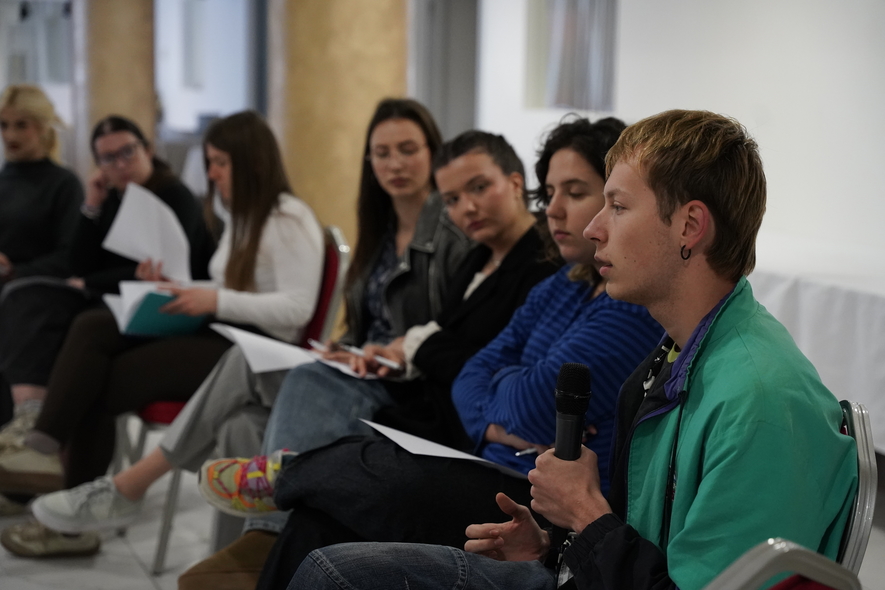
Report on the Erasmus+ exchange program “When You Say Operation Storm”.
And We Said: Operation Storm
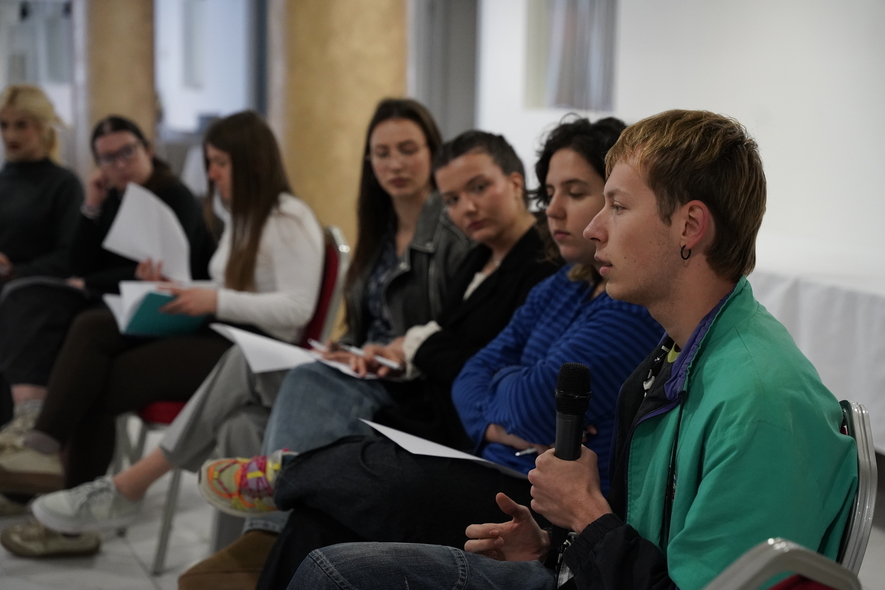
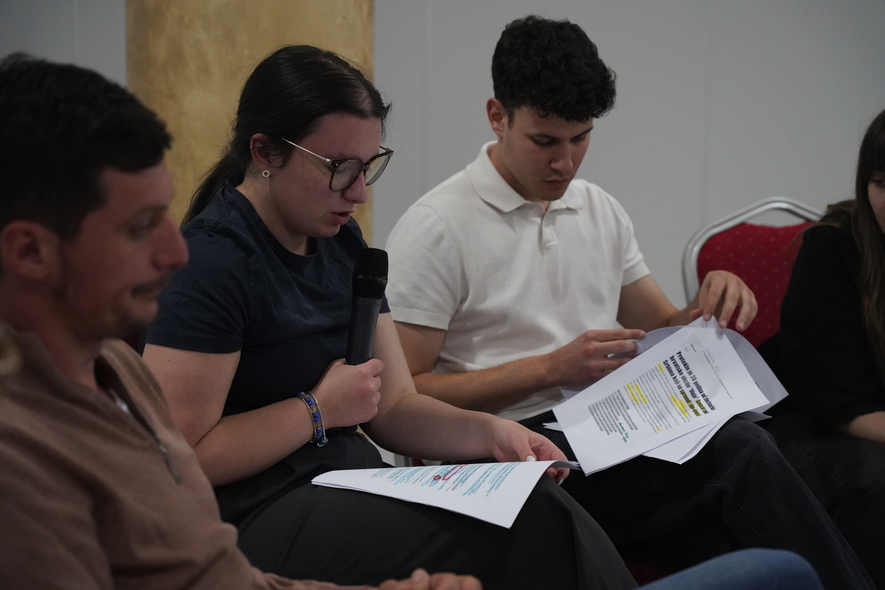
In Sisak, Petrinja, and Zagreb, from April 24 to 30, 25 young people from Serbia and Croatia talked about Operation Storm. Some came from families where Storm is never discussed, some had no connection to it at all, and some could have ended up living in completely different circumstances because of it. Together, they sat down and talked.
They talked about what occupies half of August every year, about what is discussed on several national television channels, in both Serbia and Croatia.
They studied the pages of history textbooks from their secondary schools that were skimmed over, skipped, or never reached by the end of the semester. They returned to those lines in Serbian and Croatian secondary school textbooks and, perhaps for the first time together, noticed deliberate printing errors, carefully designed narratives, and intentionally constructed propaganda.
They talked about what you learn and hear about Operation Storm while growing up in Croatia or Serbia, but also about what often remains silenced, unknown, or unspoken within those narratives.
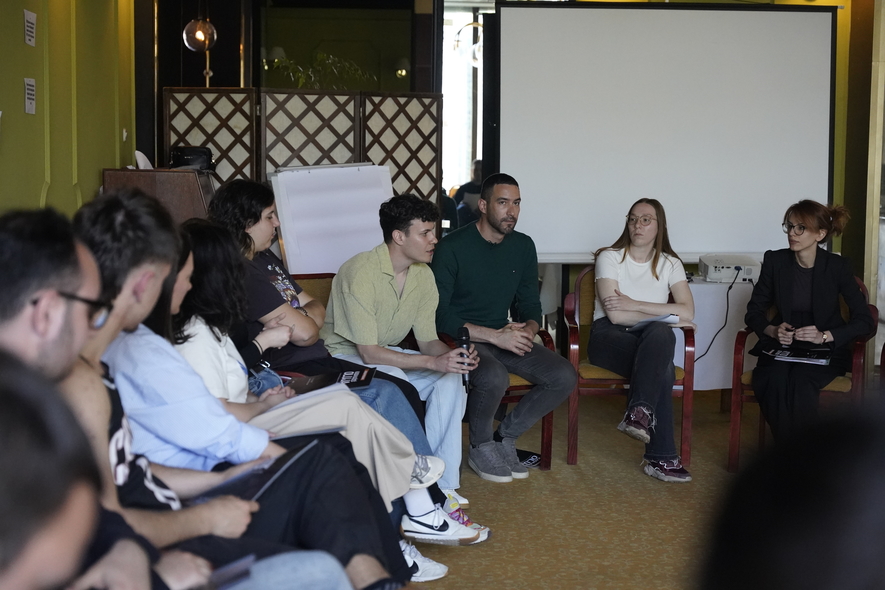
For hours, sitting in a circle, without preconceptions or easy prejudices, they spoke with those who had to leave their homes because of Operation Storm, and with those who were able to return to them because of it.
They met married couples whom the war could not separate. Those who fought for their communities, who still live there today and continue fighting for the same thing – peace.
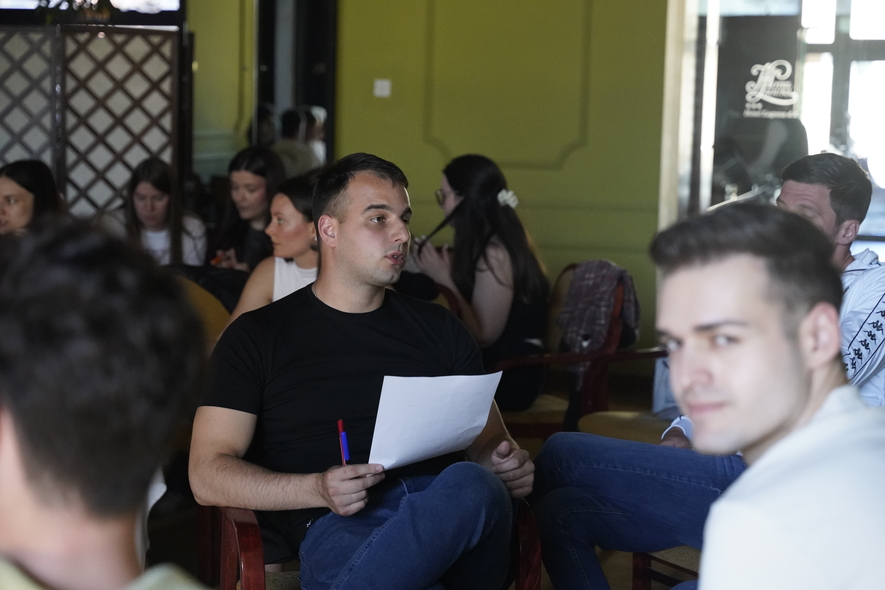
In the end, they talked to one another. About their first memories, family lunches, traumas, about what was never told and never spoken aloud. They listened to each other, both when they agreed and when they disagreed. Even when it seemed they stood at completely opposite extremes. They talked.
For five days in Sisak, Petrinja, and Zagreb, 25 young people from Serbia and Croatia tried, through conversation, mutual listening, understanding, encounters, and confrontation, to understand everything that comes to mind when you say Operation Storm. Did they agree on everything? No. Despite everything they think, believe, remember, and everything they have heard, did they manage to sit together in a circle and talk, to build their own carefully defined common narrative, based on respect for all perspectives? They did.
The Erasmus+ exchange program “When You Say Operation Storm” is part of a broader concept and methodology of creating shared narratives. We, young people from Serbia, Bosnia and Herzegovina, Croatia, Montenegro, and Kosovo, may not have had the opportunity in school to talk about what was done in our name, or to learn about what changed the course of some of our lives. But we do have the opportunity to create that space for one another. This exchange program was exactly that.
And precisely because we found a way to bypass the narratives imposed on us and build our own, the program was marked by a series of attacks, threats, and lies both before and after it took place. From a poison threat sent several weeks before the program, to public attacks by the Ministry of Croatian Veterans, in clear cooperation with the HDZ Youth, to all those who described the program as a “one-sided approach to history,” a “relativization of the Homeland War,” and to the crude and reckless lies spread by those who would prefer to preserve a state of one-sidedness, exclusivity, and silence.
They did not succeed. In Sisak, Petrinja, and Zagreb, for five days we talked about Operation Storm, about everything it meant to a veteran from Petrinja, to a refugee from its surroundings, about everything Operation Storm meant to a boy from Petrinja and a girl from its surroundings. Because in the end, what remains is the experience of one human being.
So that all of this does not remain confined to five days in Banovina, the exchange program will become part of a documentary film about a shared narrative on Operation Storm. And before you watch it, here is what those who went through this process have to say:
Previously, my first association with Operation Storm was victory; now it is empathy.
– Participant from Croatia
A sentence that largely summarized the participants’ views regarding Operation Storm was that it was necessary, but not in the form in which it happened, considering the civilian suffering and mass displacement. The focus on civilian victims, as well as the humanization of military personnel, were the aspects young people reflected on the most. I found the topic of just war particularly interesting.
– Participant from Serbia
Through the workshops, we exchanged opinions and critically questioned the ‘facts’ that are used year after year for the purpose of gaining political points. The exchange was extremely informative and encouraged us to question the narratives that surround us every day.
– Participant from Croatia
… conversations like this [within the framework of the program] are of immeasurable value. Not because they offer simple answers or a single ‘truth,’ but because they create space for understanding human experiences, fear, mistakes, and the consequences war leaves long after it formally ends. For generations who did not directly experience these events, dialogue may be the only way out of inherited narratives and lasting mutual distance.
– Participant from Serbia

Funded by the European Union. The views and opinions expressed are solely those of the author and do not necessarily reflect the views of the European Union or the Agency for Mobility and EU Programmes. Neither the European Union nor the granting authority can be held responsible for them.
Galerija