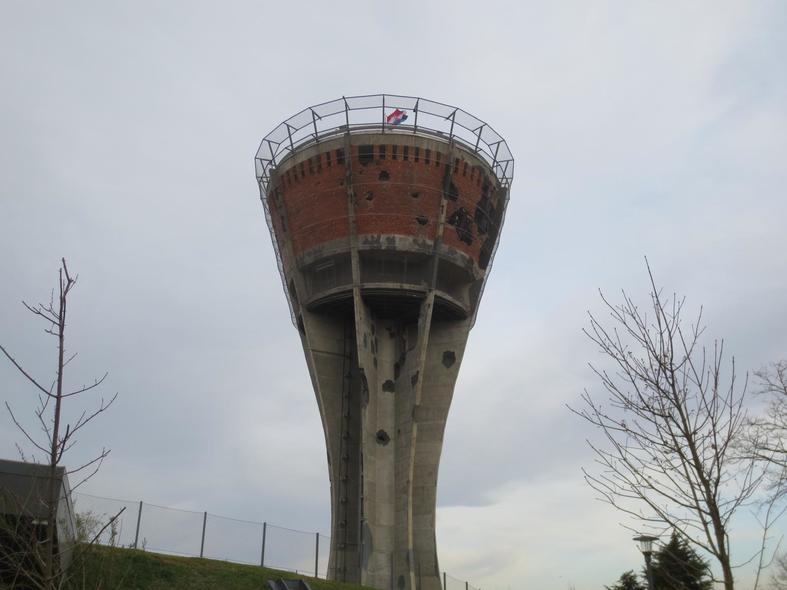
Travel report by international student Luke Litowitz, who is working with YIHR.
I am an undergraduate student at Boston College in my third year of studying International Studies with a concentration in Cooperation and Conflict. This semester, I am studying abroad in Zagreb through a program called the European Center for the Study of War and Peace, an academic center that focuses on reconciliation in the post-war setting here in Croatia.

By using the historical tensions in the Balkan region, specifically the conflict in the 1990s, we are examining how the conflict started, and the ways in which people on both sides continue to work through it today. The program explores these tensions through the lens of peacebuilding and the reconstruction of civil and international unity. ECSWP takes students on two trips throughout the semester, one of which was just last week, where we had the opportunity to visit the Jasenovac death camp and the town of Vukovar.
Jasenovac was a concentration camp constructed in the occupied Independent State of Croatia by the Ustaše during World War II. The Ustaše were an ultranationalist fascist group founded by Ante Pavelić, known for their anti-Serbian rhetoric and perpetration of violence in the pursuit of an independent Croatia separate from Yugoslavia.
The Croatian town of Vukovar also holds immense historical significance as it was the site of an 87-day Serbian invasion and bombardment during the ethnic conflict that followed the collapse of Yugoslavia in the 1990s. Croatia underwent the war of independence from 1991 to 1995, where the newly formed Croatian state military was pitted against the Serbian paramilitary forces alongside the Yugoslav National Army. The conflict was marked by widespread violence and atrocities. Vukovar became a symbol of the war as the town, located on the Serbian-Croatian border, was reduced to rubble and served as the site for ethnic violence. Rebuilt in the decades since, Vukovar stands today as both a recovered city and an unresolved wound, serving as the backdrop against which this reflection is written.

Last week I had the opportunity to travel to Vukuvar and Jasenovac with my study abroad program. We did a four-day trip, of which three were spent learning and discussing the deeply violent and painful histories of the region. The first stop was Jasenovac, where we did a walking tour and then spent time in the museum. I was greatly affected by this experience, as I had no prior knowledge of the Ustaše death camp. The numbers alone are staggering: 83,000 deaths of Serbs, Roma, Jews, Bosnian Muslims, and political dissidents are accounted for. The experience was heavy, and I was left with a very bleak outlook on humanity. I was initially discouraged by this experience, as the rawness and pain surrounding this camp were very tangible. I initially felt that the camp was deliberately preserving the open wounds of the victims, survivors, and their families, who are unable to move on from this harrowing time in Croatian history.
Despite the discouraging outlook I was left with, I would be remiss not to mention the efforts of the museum and Bogdan Bogdonovic, the architect of the symbolic, flower-shaped memorial to humanize the victims of these atrocities. While you cannot properly memorialize the victims without recalling the brutality of the camp, the focus is not on the violence itself, but on those who were subjected to it. The survivors and those who tragically lost their lives are not merely viewed as numbers or ethnicities, but as humans to be mourned and remembered. By focusing on the humans involved, I think that Jasenovac provides insight into how we all can better memorialize those who lost their lives in these conflicts, rather than remembering the division between ethnic lines, and ultimately take steps towards reconciliation and peacebuilding.
From there, we headed to Vukovar, where we saw the Memorial Hospital, Ovcara Memorial Center, and the Memorial Cemetery. It was valuable to experience the perspectives of victimhood on both sides of the conflict, with Jasenovac being perpetrated by Croatian nationalists and the siege of Vukovar being carried out by the Yugoslav National Army and Serbian paramilitary forces. This design prevented us from receiving a single-sided narrative of the historical tensions in the region.

The National Memorial Hospital in Vukovar gives visitors a vivid description through video and guided tours. We learned how the hospital received roughly 70-80 victims of violence daily during the period of bombardment and invasion. Additionally, we received a tour of the basement level of the hospital (formerly a nuclear bomb shelter), where they have reconstructed the rooms to resemble the conditions of the invasion. I was shocked to learn about the constant bombardment of the hospital, as it is illegal under international humanitarian law. The visit segwayed into our stop at Ovcara, as we learned about how over 260 people were taken from the hospital, including 10 medics, and massacred. The victims were placed in unmarked graves, and many bodies remain unfound. The missing bodies are a source of great controversy and are what I identified as a major obstacle for both sides to move on and begin reconciliation.
Our group also had the unique experience of hearing from a local hotel owner and politician, Pavao Josic. Pavao grew up in Vukovar, moved away as a refugee during the conflict, and has since returned. He gained firsthand experience of the corruption within the politics surrounding the conflict and began writing reports exposing the malpractices and corruption of local Serbian and Croatian leaders. He drove home what I now believe to be the most important lesson of this entire experience: that top-down political efforts to exploit the historical wounds of Vukovar are actively preventing both nations from healing. The painful past cannot be reconciled so long as those in power have a vested interest in keeping it raw. The calculus is cynical but clear. Local leaders on both sides have discovered that scapegoating the historical enemy wins votes, consolidates power, and sustains influence. The case of the missing bodies from the Vukovar hospital massacre is perhaps the starkest illustration of this dynamic.
Croatian leadership can mobilize the scars of the past, promising to recover the bodies, prosecute aging war criminals, and amplify nationalist grievances, to generate political favor. However, for this strategy to work, the wounds must never be allowed to close. The moment ordinary people begin to forgive and move forward, the campaign platform collapses with it. Serbian leaders, meanwhile, run the mirror image of the same game, building power by positioning themselves against Croatian nationalism, while quietly depending on the same unresolved tensions to remain relevant. Both sides profit. And both sides need the conflict to fester. Who pays the price? The families of the victims, who cannot properly mourn their dead. And the young generations born into a society still defined by a war that ended thirty years ago, inheriting a wound they did nothing to create, and that their leaders have every incentive never to heal.
While listening to Pavao, I identified similar rhetoric in modern American politics, something that I have far more experience with. While the scale and stakes are very different, American politicians utilize historical wounds from American history to gain political capital while weaponizing the “other.” The most striking example that I made a connection to is race politics in the United States that rely on open wounds left over from the Jim Crow South and the American Slave trade. Conservative politicians mobilize votes by inspiring fear of “white replacement” and the rewriting of history. This is present in efforts to dismantle critical race theory and DEI initiatives. While liberal politicians mobilize minority voters by emphasizing ongoing injustice and institutional racism. Both sides, at their worst, rely on outrage rather than participating in efforts to pursue the slow and hard work of active reconciliation and reform. While the scope is different than the case in Vukovar, both examples depict leaders actively preventing historical wounds from healing while jockeying for political power. In America, this perpetuates ongoing racial tensions, while in Vukovar, ethnic tensions remain from a conflict that ended 30 years ago.
While grappling with this experience, one conclusion feels increasingly clear: the most promising path toward healing is not found in the halls of government, but at the grassroots level, through education, peacebuilding, and the slow, unglamorous work of human connection. This can take many forms. The construction of shared historical narratives, ones that acknowledge suffering on all sides without weaponizing it, can begin to loosen the grip of the zero-sum stories that politicians prefer. So too can the creation of physical and social spaces where Croatians and Serbians simply exist together: not to debate the war, not to assign blame, but to recognize one another as neighbors, as human beings, as people who share more than they have been taught to believe.
The most critical investment is in the youth. They did not start this conflict, yet they are born into its atmosphere, absorbing resentments they never chose and inheriting divisions that serve only those in power. If reconciliation has a future in this region, it runs through them. Perhaps the most quietly radical insight I encountered came from a local NGO worker who described his approach with incredible simplicity: he creates spaces for Croatians and Serbians to spend time together without any discussion of the conflict whatsoever. No structured dialogue. No formal reconciliation framework. Just shared experience. The effect, over time, is that people begin to see through the ethnic categories they've been handed. They discover, often with surprise, how much they have in common. Humanization does what politics cannot. Peacebuilding, it turns out, doesn't always need to announce itself.
Sometimes it just looks like people in a room together, slowly unlearning how to be enemies.
-Luke Litowitz